
5 Signs It’s Time for New Tires or Tire Service
Whether you are navigating the heavy winter snows of Erie, towing a heavy trailer with your GMC Sierra 1500, or taking the family out in your GMC Yukon, your tires are the single most critical point of contact between your vehicle and the road.
A GMC truck is celebrated for its rugged power, and a GMC SUV for its
premium reliability. However, much of that capability, safety, and fuel
efficiency relies heavily on the health of your tires.
At Rick Weaver GMC, we know that regular tire maintenance extends the
lifespan of your vehicle and keeps you safe on the road.
To help you stay ahead of potential issues, our certified Service
experts have put together this comprehensive guide on tire maintenance
schedules, essential upkeep tips, and the top five warning signs that it is
time to visit our service center for professional tire service or a brand-new
set.
5
Signs It’s Time for New Tires or Urgent Tire Service
Even with meticulous care, tires eventually wear out. If you notice any
of the following five warning signs while driving around Erie, it is time to
schedule a visit to the Rick Weaver GMC Certified Service center.
1. Visible Tread Wear Indicators or Low Tread Depth
Modern tires come equipped with built-in Tread Wear Indicators; flat
rubber bars molded perpendicular inside the tread grooves. If your tire tread wears
down to the level of these bars anywhere on the tire, it is no longer safe or
legal to drive on.
Even if the wear is localized to just one edge due to a bad wheel
alignment, a single bald spot drastically increases your risk of a sudden
blowout under the weight of a heavy payload.
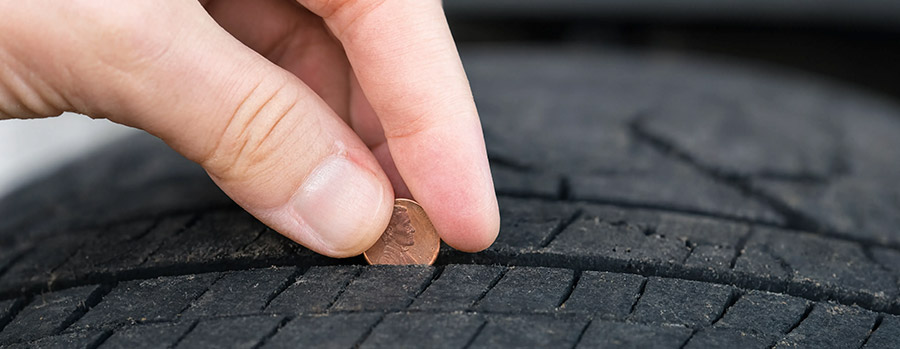
The Penny Test: Place a standard Lincoln penny upside down into a tire groove. If you
can see the top of Lincoln's head, your tread depth is below 2/32 of an inch.
This means your tires lack the depth required to safely channel water,
drastically increasing your risk of hydroplaning.
2. Sidewall Damage (Cracks, Bumps, or Bulges)
While tread issues develop over thousands of miles, sidewall damage can
happen instantly after hitting a curb or a deep pothole. Inspect the outer
walls of your tires regularly for:
- Bumps or Bulges: These indicate that the internal structural cords of the tire have failed, causing air to push against the flexible outer rubber layer. A bulging tire is a ticking time bomb for a high-speed blowout.
- Cracks or Cuts: Deep grooves or splits in the sidewall that reveal the internal fabric or cord means the integrity of the tire is compromised. Sidewall damage cannot be patched or repaired; it requires immediate replacement.
3. Abnormal Vibrations or Shaking While Driving
It is natural to feel some vibration on rough roads, but if you
experience a persistent shudder or vibration through your steering wheel, seat,
or floorboards on smooth pavement, your tires need professional attention. This
symptom typically points to three potential issues:
- Tires that have fallen out of balance.
- A severely misaligned suspension.
- Internal tire damage, such as a shifted belt or flat spot.
Ignoring these vibrations accelerate wear on your vehicle's steering
components and suspension, turning a simple tire service into a costly repair.
4. Constant Pressure Loss (Underinflation Issues)
If you find yourself frequently stopping at an air pump to clear a
low-pressure warning light on your dashboard, you have a problem. Constant
pressure loss usually stems from a slow puncture caused by a nail or screw, a
faulty valve stem, or a poor seal along the wheel rim.
While small punctures within the central tread area can often be
repaired by our technicians, continuous underinflation causes the tire to
overheat, destroying its internal structure and ruining its fuel efficiency.
5. Uneven Tread Wear
When inspecting your tires, look closely at the wear patterns across the
width of the tread.
- Wear on both outer edges typically indicate chronic underinflation.
- Wear straight down the center points to overinflation.
- Wear restricted to just one side (cupping or feathering) signals that your wheels are out of alignment or that your suspension components are worn.
Catching uneven wear early allows our team to correct the alignment or
rotation schedule, saving your remaining tread before you need a total
replacement.
The
Recommended GMC Tire Maintenance Schedule
Tire maintenance should not be reactive. Following a structured schedule
ensures even tread wear, preserves handling characteristics, and optimizes your
fuel economy.

1. Monthly Pressure Checks
Tire pressure fluctuates with temperature changes, which is especially
noticeable during changing seasons in Northwest Pennsylvania. Check your tire
pressure at least once a month when the tires are cold (driven less than one
mile or parked for at least three hours). Always refer to the Tire Information
Label on the inside of your driver’s doorframe for the correct specifications, not
the maximum PSI listed on the tire sidewall itself.
2. Tire Rotations (Every 7,500 Miles)
Because each tire position handles different steering, braking, and
weight distribution loads, tires wear down at uneven rates. Rotating your tires
every 7,500 miles—conveniently matching your routine oil change interval—promotes even wear. This allows you to replace your
tires in sets of four, which preserves optimal traction and safety.
3. Wheel Alignment and Balancing (Annually or As
Needed)
Potholes and rough roads can easily jar your suspension out of
alignment. An annual alignment check ensures your tires travel straight,
preventing premature inner or outer tread wear.
|
Service
Interval
|
Required
Maintenance Action
|
Primary
Benefit
|
|
Monthly
|
Cold Tire
Pressure Check
|
Optimizes fuel
economy and prevents blowouts
|
|
Every 7,500
Miles
|
Tire Rotation
& Balance
|
Extends tread
life and ensures even wear patterns
|
|
Every 12
Months / As Needed
|
Wheel Alignment
Inspection
|
Prevents
vehicle pulling and protects suspension
|
Essential
Tire Maintenance Tips for Drivers
- Avoid Overloading Your Vehicle: Check your GMC owner’s manual for load capacity limits. Excess weight strains your tires, accelerating heat buildup and wear.
- Keep It Clean: Wash away road salt, brake dust, and mud. These elements can degrade
the rubber compound over time.
- Inspect Your Spare: Don't forget your spare tire. Even an unused spare tire degrades over
time and should be replaced every 5 to 6 years.
- Drive Mindfully: Avoid harsh braking, rapid acceleration, and fast cornering, all of which strip tread away prematurely.
Get Professional Service at
Rick Weaver GMC
Your tires are the foundation of your GMC’s safety, handling, and fuel
efficiency. Whether you are tracking routine upkeep like monthly pressure
checks and 7,500-mile rotations or keeping an eye out for critical warning
signs like sidewall bulges and uneven wear, proactive maintenance is key to
preventing minor issues from turning into costly safety hazards.
At Rick Weaver GMC, our focus is ensuring your vehicle remains
aligned with its original factory engineering specifications. Prioritizing
correct load ratings, proper wheel alignment, and timely tire replacements not
only extend the lifespan of your tread but also protects your vehicle’s
underlying suspension and drivetrain.
Regularly inspecting your tires ensures your truck or SUV stays dependable, efficient, and safe on the road.